Sri Lanka Rugby fraternity: A Systemic Failure (Part One)

With an average 2015/16 club season, a failed Asian 15’s competition, a drubbing in the Olympic 7’s qualifications and a controversy riddled schools season, we are forced to question ourselves ‘what  is causing such abysmal failures’.

The only way to describe this colossal bungling is ‘a systemic botch’. All stakeholders of the rugby community must take full responsibility for these laughably repetitive catastrophes. Administrators, coaches, players, referees, sponsors, the media, and even the fans must take accountability for these disasters. Considering the plethora of concerns Sri Lanka faces domestically, it is quite an accomplishment to have had the little success the Tuskers have managed so far.

This two part serial is a rather disconsolate attempt to delve into the issues plaguing our favourite sport. Part one will highlight on- field issues while part two will look at off field issues such as administration, fans, media, sponsors etc.

Referees

The standard of refereeing in Sri Lanka is a vociferously debated subject in the circles with pundits slamming it ‘ridiculous’ and waging how these decisions adversely impact the game in Sri Lanka. The best referees in the world have said “no one should know the name of a referee by the end of a game”, sadly in Sri Lanka, we know the names of almost every referee at the end of the game.

Garratt WilliamsonBefore augmenting the issues it has to be said most of it stems from administrative failure. There is no system of accountability. It is a professional system with an amateur governance model. From December 2014 to February 2016 Garratt Williamson, an internationally renowned referee, worked for the referee’s union, training and developing referees and there was some growth in the standard of refereeing in Sri Lanka. However, changes left Williamson stranded and with him out of the picture all development seems to have peeled back to square one. The fact that Sri Lankan referees had the opportunity to learn from a test level referee and let it slip away is quite preposterous.

Firstly, the number of top level referees is a far too small for the amount of rugby being played in Sri Lanka. There needs to be a system in place to introduce and develop former players to refereeing. Referees like players need to be given a full time career options where they can become professional referees with room for growth.

Referee in good positionMoreover, the few refs aligned to the union get very little training and don’t seem to be held accountable for their actions on the field. The referees in Sri Lanka appear to have a phobia about learning and seem averse to adapting with the times.  If fitness is not on par they will struggle to get into position. Top level referees are expected to be as fit as a loose forward. Referees are tested on a monthly basis but are they being held accountable for their fitness levels?

(funny head scratching pic)The referees also seem to have no knowledge of the modern game. More often than not players, coaches, and fans are left scratching their heads, having no idea as to what the decisions are. They often appear to be lost to the laws of advantage work and are never able to create a free flowing game.

Additionally, their decision making powers under pressure and their ability to control the game is appalling. They need to learn how to make decisions in critical areas and how to convey those decisions and instructions clearly to players, coaches and fans. This will shrink many an altercation with fans.

Coaches

There is an absence of overall structure within the coaching system in Sri Lanka, with no long term plans, accountability and direction, from grassroots all the way up to the national side.

From an administrative stand-point, there is no registration or accreditation required to be a coach in Sri Lanka. Officials need to invest in coaching clinics and development programmes Boys practisingfor coaches. Coaching is a great career opportunity for retiring players and they must be provided a platform to learn and adapt to becoming a coach. At present there is a level one programme every 3 months and level 2 twice a year in Sri Lanka. This is woefully inadequate. The level one programme is extremely basic with just an eight-hour course where the only thing required to qualify is, attendance.
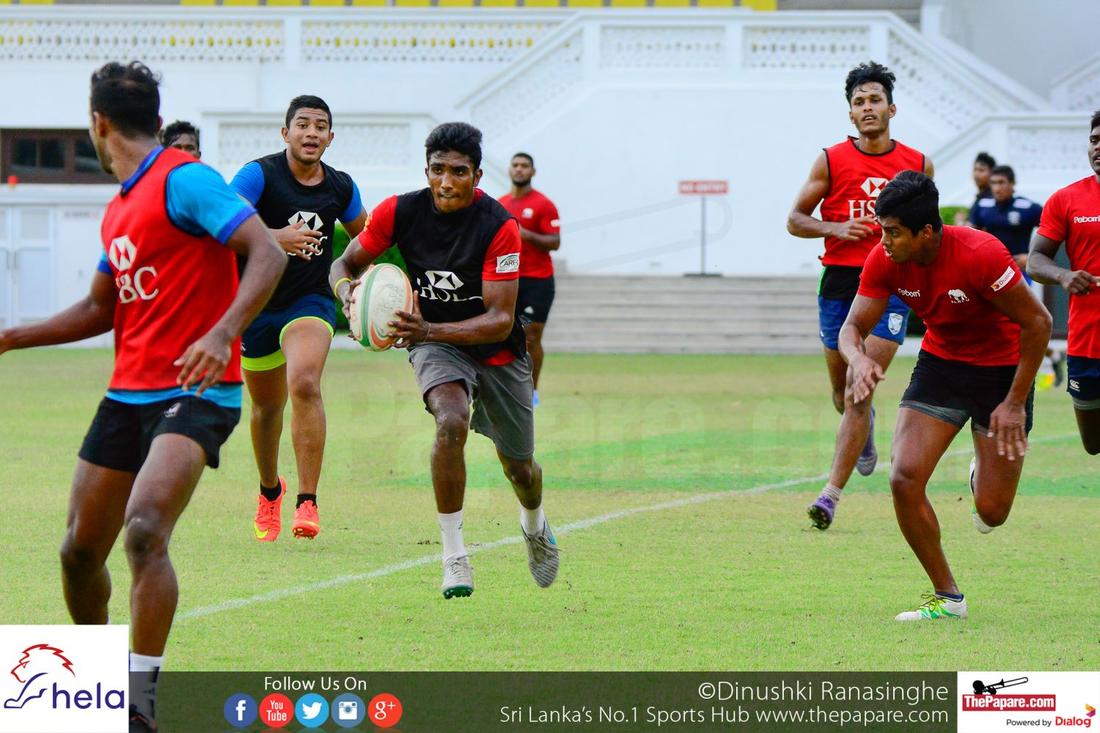
At the school’s level, coaches are forced to focus on short term success and as a result, we see very little development for the future. Schools rugby is the only form of development that young players get and it is crucial that the fundamentals are instilled in players at a young age.

Sri Lanka has numerous junior coaches that hold little knowledge of the basics and have even less knowledge of how to instill them in young players. So often we see players coming into 1st XV and under 18 sides with no knowledge of the basics and as a result, it is impossible for senior coaches to build teams as they have to focus on the individual basics rather than work on developing a team. This lack of development at junior ages, forces coaches to micro-manage teams at senior level and this means players never learn to make decisions on the field under pressure. A coach’s job is to prepare players for the game, once the team takes the field the captain and senior players have to make all the decisions but in Sri Lanka, they look to the bench for virtually every decision and when they do not look to the bench they almost always end up making the wrong decision.

small boys being coached)In order for Sri Lanka to grow, players being taught the ABCs of rugby at under 10, 12 and 14 in imperative. Coaches of these age groups will do well to teach players to catch, pass, kick and run with the ball in attack and teach them how to tackle and go into contact in safely. They must also instill in them, the laws, rules, and regulations of the game and importantly the spirit in which to play the game.

Once players reach the U 16 and under 18 stage, the fundamentals need to be down to muscle memory and a coach can start to work on the player’s decision making skills. They can teach them when and where to implement all the basics they’ve learned at a young age and can also work on teaching their players how to work around the break down and start working on set pieces in detail.

If these aspects are drilled into players at a young age, once they reach the under 20 level coaches can start implementing more structure and in-depth game plans. Coaches can also work on developing players mentally, teach them to deal with pressure and adapt to what is happening on the field. They can work on helping players come together as a team without having to worry about teaching basics.

With all these skills players coming out of the school’s system, players will be fully equipped to make the move to professional rugby. If this system can be implemented correctly club coaches and National coaches will find it much easier to assimilate good players into their squads.

Players

A lot of criticism must be placed on the top level players as well. The attitude of most players in the schools and club league is very amateurish. Very few players are keen to work on and improve their game on a daily basis and their priorities are not in order. Far too many players seem content with being just average and don’t have the drive to push themselves to be the best.
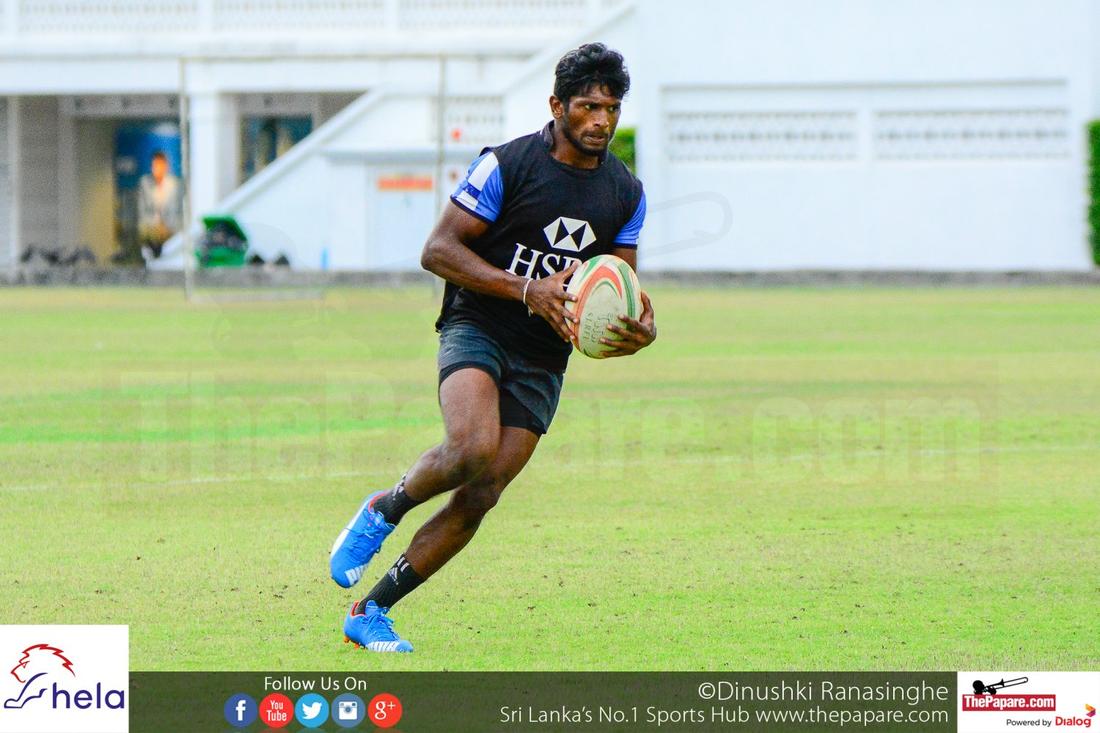
Practising aloneVery rarely do players work on their game individually. Basic individual skills can be developed and perfected by players on their own. Skills like kicking, passing, lineout throwing and high ball collections are all individual skills that players at the highest level need to have down to muscle memory. Athletes must also make the effort to improve on their strengths whilst still working on their weaknesses.

Players must also take the time to work on strength and conditioning levels in the off season. Stamina, strength, speed, and agility are all aspects that players can work on alone which will, in turn, grow their individual performances.

Additionally, players need to develop their game- knowledge, by repeatedly watching game footage both of international players as well as of themselves. They have to spend time studying what needs to be worked on and how they can work on it.

The biggest issue plaguing those involved on the field is a lack of overall structure within the game. Everything seems very ad-hoc and there are no systems in place to expand and build on what is a very good amateur foundation.

There is no synchronization between players, coaches and referees. Countries like New Zealand consistently produce brilliant rugby teams is the cohesion between all branches of the game. They encourage healthy debate and have primary and secondary goals for both the short term as well as long term expectations.

There also appears to be lack of culture within the rugby fraternity. Most of the stakeholders mentioned above have very little knowledge of the unwritten rules of how the game should be played; the spirit of the game which makes rugby the greatest sport in the world (in this writer’s opinion). Everyone, from players to coaches to referees to administrators to journalists to sponsors to fans need to make a conscientious effort to develop themselves and in turn grow the game.

The upcoming Sri Lanka Sevens tournament is certainly a step in the right direction.  There are obviously many individuals who work tirelessly to develop and grow the sport. While being grateful to them, let’s hope this collective ‘nudge’ inspires the others.

England, Ireland and Wales to face Southern Giants

England, Ireland and Wales to face Southern Giants

England, Ireland, and Wales will face off against Australia, South Africa, and New Zealand respectively in a 3 match series over the next 3 weeks. This will be the first time the southern giants make an appearance on the international stage since dominating the Rugby World Cup eight months ago.

England vs Australia

England vs Australia
ADRIAN DENNIS/Getty Images

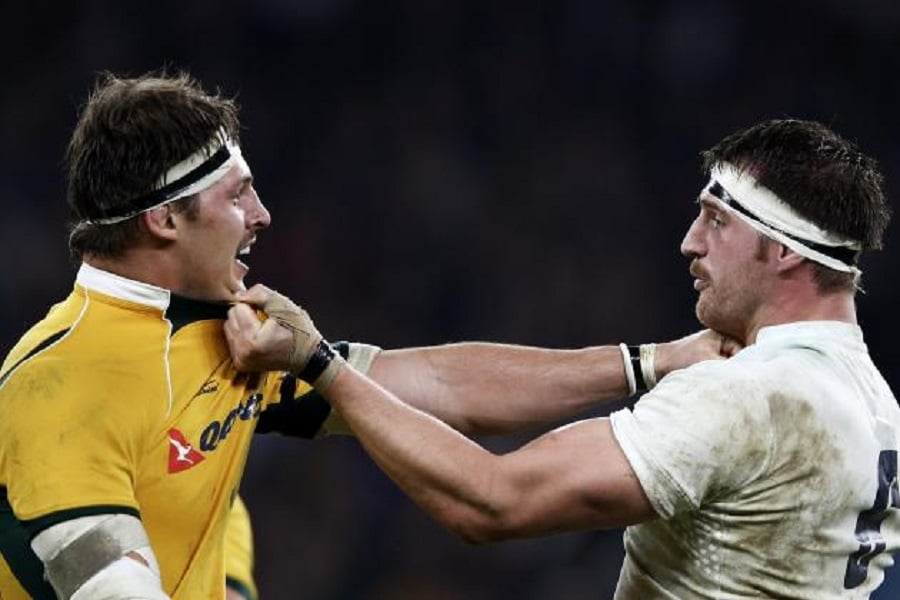
England will play the Wallabies in Brisbane, Melbourne and Sydney on the 11th, 18th, and 25th of June and will be led by Grandslam winning captain Dylan Hartley whilst the Wallabies will be skippered by World Cup captain Stephen Moore.

England team: 1. Mako Vunipola, 2. Dylan Hartley, 3. Dan Cole, 4. Maro Itoje, 5. George Kruis, 6. Chris Robshaw, 7. James Haskell, 8. Billy Vunipola, 9. Ben Youngs, 10. Owen Farrell,  11. Marland Yarde 12. Luther Burrell, 13. Jonathan Joseph, 14. Anthony Watson, 15. Mike Brown; Replacements: 16. Luke Cowan-Dickie, 17. Matt Mullan, 18. Paul Hill, 19. Joe Launchbury, 20. Courtney Lawes, 21. Danny Care, 22. George Ford, 23. Jack Nowell.

Eddie Jones has selected a physical match day 23 for the first test, indicating the English are likely to play a tight game utilizing their powerful forwards to carry in midfield whilst trying to create space for the likes of Anthony Watson and Mike Brown. Jones has opted for the in-form Owen Farrell at 10 ahead of George Ford.

Australia team: 1. Scott Sio – 2. Stephen Moore (c), 3. Greg Holmes, 4. Rory Arnold, 5. Rob Simmons, 6. Scott Fardy, 7. Michael Hooper(vc), 8. David Pocock, 9. Nick Phipps, 10. Bernard Foley, 11. Rob Horne, 12. Samu Kerevi 13. Tevita Kuridrani, 14. Dane Haylett-Petty, 15. Israel Folau; Replacements 16. Tatafu Polota-Nau, 17. James Slipper, 18. Sekope Kepu, 19. James Horwill, 20. Dean Mumm, 21. Sean McMahon, 22. Nick Frisby, 23. Christian Leali’ifano.

Wallaby Coach Michael Cheilka has picked 4 debutants in his match day 23 in Rory Arnold, Samu Kerevi, Dane Haylett-Petty and Nick Frisby. The Wallabies biggest strength will be their work rate around the breakdown. Their back row combination was the most effective through the World Cup with Fardy, Hooper, and Pocock all forcing turnovers of the Wallabies. The Wallabies are expected to play a more open brand of rugby with the likes of Folau and Kurindrani exploiting any space out wide.

Series Prediction- Australia 2-1

Ireland vs South Africa

Ireland vs South Africa
Photo Credit: Rugby Live

South Africa will front up in Cape Town on the 11th, Johannesburg on the 18th, and Port Elizabeth on the 25th. Both teams will be led by their hookers, Adriaan Stauss for the Springboks and Rory Best for the Irish.

South Africa team: 15 Willie le Roux, 14 JP Pietersen, 13 Lionel Mapoe, 12 Damian de Allende, 11 Lwazi Mvovo, 10 Pat Lambie, 9 Faf de Klerk, 8 Duane Vermeulen, 7 Siya Kolisi, 6 Francois Louw, 5 Lood de Jager, 4 Eben Etzebeth, 3 Frans Malherbe, 2 Adriaan Strauss (captain), 1 Tendai Mtawarira. Replacements: 16. Bongi Mbonambi, 17. Trevor Nyakane, 18. Julian Redelinghuys, 19. Pieter-Steph du Toit, 20. Warren Whiteley, 21. Rudy Paige, 22. Elton Jantjies, 23. Jesse Kriel

Allister Coetzee has taken over the reigns as the coach for the Bokke and has opted for a young side. The South Africans are missing numerous senior players due to injuries and retirement. However, they will stick to their tried and tested structure with a lot of physicality up front. Their massive forwards will look to give them the go-forward ball with hard carries while the likes of le Roux and Pietersen will look to create space out wide.

Ireland team: 15. Jared Payne, 14 Andrew Trimble, 13. Robbie Henshaw, 12. Luke Marshall, 11. Keith Earls, 10. Paddy Jackson, 9. Conor Murray, 8. Jamie Heaslip, 7. Jordi Murphy, 6. CJ Stander, 5. Devin Toner, 4. Iain Henderson, 3. Mike Ross, 2. Rory Best (captain), 1. Jack McGrath. Substitutes: 16. Sean Cronin, 17. Finlay Bealham, 18. Tadhg Furlong, 19. Ultan Dillane, 20. Rhys Ruddock 21. Kieran Marmion, 22. Ian Madigan, 23. Craig Gilroy.

Joe Schmidt also fields a young squad with the likes of Johnny Sexton, Sean O’Brien, and Rob Kearney missing out. The Irish will rely a lot on their 3rd row with Murphy, Stander, and Heaslip looking to give them go forward ball. They will also look to Conor Murray to control the backline as the most experienced player among the backs.

Series Prediction- South Africa 3-0

New Zealand vs Wales

New Zealand vs Wales
photo Credits: allevents.in

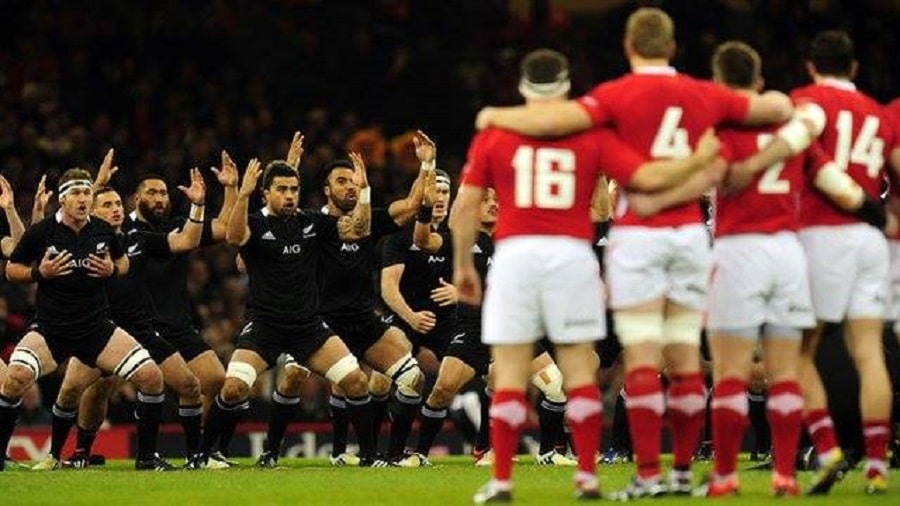
The Welsh will face the world champions in Auckland, Wellington and Dunedin over the next three Saturdays with hopes of challenging a relatively new look All Blacks team. The All Blacks are led by Kieran Read whilst Sam Warburton will lead the Welsh.

New Zealand team: 15 Ben Smith, 14 Waisake Naholo, 13 Malakai Fekitoa, 12 Ryan Crotty, 11 Julian Savea; 10 Aaron Cruden, 9 Aaron Smith; 1 Joe Moody, 2 Dane Coles, 3 Owen Franks; 4 Luke Romano, 5 Brodie Retallick; 6 Jerome Kaino, 7 Sam Cane, 8 Kieran Read (c). Replacements: 16 Nathan Harris, 17 Wyatt Crockett, 18 Charlie Faumuina, 19 Patrick Tuipulotu, 20 Ardie Savea, 21 TJ Perenara, 22 Beauden Barrett, 23 Seta Tamanivalu.

 The All Blacks will stick to their fast paced structure with a lot of interplay between the forwards and backs. The Kiwis also field some youngsters with Ryan Crotty and Fekitoa combining in the centers and Naholo returning to the wing. Their defensive structure will be impenetrable whilst the likes of Barrett and Ardie Savea will come off the bench to add impact late in the game.

Wales Team: 15. Liam Williams, 14. George North, 13. Jonathan Davies, 12. Jamie Roberts, 11. Hallam Amos, 10. Dan Biggar, 9. Rhys Webb, 1. Gethin Jenkins, 2. Ken Owens, 3. Samson Lee, 4. Bradley Davies, 5. Alun Wyn Jones, 6. Ross Moriarty, 7. Sam Warburton(c), 8. Taulupe Faletau.Replacements: Scott Baldwin, Rob Evans, Tomas Francis, Jake Ball, Ellis Jenkins, Gareth Davies, Gareth Anscombe, Scott Williams.

Wales field a good blend of experience and youth and will be very close to a full strength side. Their tight five will be rock solid in the set-pieces whilst the back row will be effective around the breakdown. Their center pairing is one of the most tried and tested in the world and the battle between George North and Julian Savea on the wing is absolutely mouth watering.

Series prediction- All Blacks 3-0.

Where have all the good men gone?

Where have all the good men gone?

From a very young age, we were taught that Rugby was a ‘hooligans game played by gentlemen’, sadly this seems to be an idea lost in the Sri Lanka schools rugby community.

Over the past five years, there have been numerous incidents both on and off the field that have been a disgrace to the sport we love, only to be dismissed time and again as one-off incidents, heat of the moment etc.Isipathana and trinity together

Apparently the time where players battered each other for 80 minutes, only to cultivate a lifelong friendship thereafter seems lost. The time when fans would join in toasting the victors whilst commiserating the losers is apparently a thing of the past.

Rugby like most other sports has unwritten rules, a spirit of the game that has to be upheld by all those involved, be it spectator or player. The first of these unwritten rules is that the referee’s word is final. There has been a recent unhealthy trend for fans to blame the officials when their sides lose. Coaches and players have to take responsibility for their own deficiencies or under-performance. Few referees get it right all of the time and, though some seem to make more errors than others, there is a process whereby complaints can be lodged 11162083_10153831427854251_8032440414727505379_nby officials. This system must be respected if the game is to thrive in the future. The crowd invading the field and bludgeoning the referee is not going to change the outcome of the game. It is true the standard of refereeing in Sri Lanka is not to be revered and it does not seem to be changing for the better in a rush. However, all those involved in the game have got to realise that the referees decision is final, no matter the consequence.

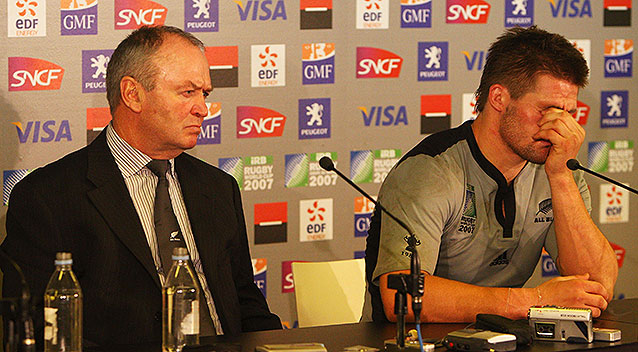
The most famous argument for this case is that in 2007, the mediocre refereeing cost the All Blacks the quarter-final of the RugbyWorld Cup, which let’s be honest is far more important than any school’s rugby game in Sri Lanka. How the All Blacks reacted to this, is a valuable lesson to every rugby follower and should be emulated. Following the 2007 loss every one of the players, coaches, administrators took it upon themselves to accept responsibility.

In his autobiography the captain of that side, Richie McCaw talks about how his coach at the time Graham Henry pulled him aside prior to the post-match press conference and said “we’re going to front up, play it straight down the line, pay the French respect, and as much as we might feel we have gripes, there’ll be no whingeing.” This attitude earned them the respect of the entire global rugby community including the rugby-mad fans of New Zealand. If only Sri Lankan schoolboys had similar examples.  Instead, they are subject to watching middle-aged men surrounding and assaulting a referee within seconds of the game ending. How can we expect the next generation to do any better when these are the scenes they grow up watching.

Learning to accept defeat is something the entire rugby community needs to do. Could it be that the pressure we are putting on these youngsters to win is too much? It is drilled into them from day one, how important winning is. The culture we are creating is, win at all costs and apparently that is creating sore losers. Rugby, like life gives you victory and defeat along with heartbreak and triumph and if we don’t teach youngsters to deal with it in rugby, how do we expect them to deal with it in life? In rugby, you are expected to accept both winning and losing, with equal grace. Losers never make excuses and winners never gloat. Apparently the majority of the fans on social media never got the memo. Whether it is accusing a referee of cheating or a reporter of being biased, the negative posts always seem to outweigh the positive. Fans find it extremely easy to come to the defence of heinous acts while still criticizing excellence purely to support their individual ideologies.

Another unwritten rule of rugby is that once you walk off the field you are expected to be the best of friends. For 80 minutes you are merciless toward each other, but the moment that whistle goes nothing matters. Some of the greatest friendships in Sri Lanka’s previous generations were born on the rugby field. This was a notion prevalent in Sri Lanka rugby in the past but seems to be lost to the new generation.

There used to be a tradition in some schools where, when they hosted a junior rugby game they would give the visiting team players a milk packet and banana following the game. The two teams would then stand together in awkward silence around a bench or under a tree, sometimes watching the ‘aiyas’ playing sipping their milk packet and chomping down their banana. It was not a big deal and the coaches and masters in charge would repeatedly attempt to force the players to interact to no avail. It may not have been much and rarely created dialogue but it did humanise opponents. It gave youngsters the feeling of “they are just like us”. This took away that stigma that competitors were the enemy, it created anTP-49atmosphere where players learned to respect each without uttering a single word.   You also used to clap your opponent off the field where naturally any simmering resentment is nipped the bud.  For schools, making the pre-game line-up and introductions should also be made mandatory as a means of steeping the youngsters in tradition and unwritten codes early on, respect, respect, respect.

At the conclusion of some traditional encounters the host teams invite the visiting teams for a shared dinner. Whether it’s just the two teams in the dining hall of the host team or whether it is large gathering of old boys, parents and officials, this tradition provides opportunities for players to interact and cultivate friendships. No matter the scale be it a formal dinner or players  simply sharing a meal after the game replicating the traditional sharing of a pint by sportsmen the world over, it is a vital tradition and should be implemented at some level.

Every school whether it be the self-proclaimed elite Schools that have competed at the top for generations or the newcomers to top level competition, is responsible for this farce we now call schools rugby. All these schools field exceptional talents, that are completely undercut by the belligerent behaviour of those gone before them who vainly attempt to re-live their glory days through these young men. In turn, the example set for the next generation is that of chaos and rivalry instead of friendship and camaraderie.

No matter the game, be it the Bradby in Pallakele or under 12 games played in a dust-bowl by unheard of teams, the virtues and values of the game must be taught. From old boys to present boys, from parents to well-wishers, from administrators to coaches it is our job to uphold and carry on tradition whilst still evolving with the times and heightened competition.

All Blacks Strength in Depth

The All Blacks; Strength in depth

World Champions

With the mid-year tours just over a month away, many experts have begun making predictions on how the number one rugby team in the world will turn out moving forward.

All Blacks win Laureus AwardThe New Zealand All Blacks move into the 2016 season on the back of what has been perhaps the greatest era in rugby history. The 3-time world champions have accumulated every accolade available to them in the sporting world. From being named World Rugby team of the year 8 times in the past decade to becoming the first rugby team in history to win back to back world cups, the All Blacks have conquered it all including being named the Laureus sports team of the year in 2016.

next captain and current coachFollowing all the accomplishments of the last decade, the Kiwis must now move forward without a majority of the men who helped mold this group into the global force it is. With the likes of Richie McCaw, Dan Carter, Keven Mealamu, Tony Woodcock, Conrad Smith and Ma’a Nonu all making their exit from New Zealand rugby, it is now up to the next generation of New Zealanders to carry on the legacy. It is exactly at this point where the revolutionary planning of the All Blacks coaching staff and administrators come into play. Steve Hansen and his predecessor Graham Henry created a system where young players were groomed whilst the existing stars are still at their peak and New Zealand now has a wealth of depth for the coaches to pick from. From front row forwards to play-makers to impact players the All Blacks staff have a gargantuan number of options when selecting their squad.

Front row

dane colesAt loosehead prop, although they no longer have the immensely experienced Tony Woodcock the Kiwis have players like Wyatt Crocket and Joe Moody who both have experience in the black jersey. New Zealand also has the established Owen Franks and the Powerhouse Charlie Faumuina both vying for the tight-head prop spot while Nepo Laulala has to be included in the discussion moving forward. In the number 2 jersey, the All Blacks have perhaps one of the best hookers in world rugby in Dane Coles. With his ability at the breakdown and in loose Coles plays the role of a 4th backrower whenever he is on the field. The selectors also have the likes of Hika Elliot and Codie Taylor who can both fit in seamlessly to the All Blacks pattern of play.

With this blend of youth and experience, the All Blacks will field one of the most formidable front rows in world rugby.

Second row

retallick and whitelockAt lock, the Kiwis will most likely field the tried and tested combination of Brodie Retallick and Sam Whitelock. Retallick has been one of the most dominant players in the world over the last two years whilst Whitelock’s arial dominance is unquestionable. They will also have the likes of Dominic Bird, Luke Romano, Patrick Tuipolotu and James Broadhurst who can provide cover and make an impact off the bench.

Third row

On the blind side flank coach, Steve Hanson will likely stick with the powerhouse Jerome Kaino, with youngsters like Steven Luatua and Jordan Taufua competing hard for the number 6 jersey. At openside, All Blacks will have to cope without the inspirational Richie McCaw. Sam Cane has been tipped to step into the shoes of the former skipper but will have stiff competition from Matt Todd and Ardie Savea, both of whom have been exceptional thus far in Super Rugby. Kieran Read will almost certainly slot in at number 8 and will take over duties as captain. Victor Vito will provide cover in the third row with his ability to play all three positions.

Inside halves

Aaron Smith is undoubtedly the first choice half back for the selectors, whilst having serious competition from Tawera Kerr-Barlow, TJ Perenara, and Brad Weber. The vastly experienced Andy Ellis is also in contention for a spot if he is required.

Carter helps crudenAs for the first five-eighth, the All Blacks must manage without the mercurial, Daniel Carter. Aaron Cruden and Beauden Barrett who were considered understudies to Carter for the past four years will have to step into the veteran’s shoes and marshall the best team in the world. Steve Hansen also has the option of Lima Sapoaga who has been extraordinary over the last two years and will definitely be in contention for the number 10 jersey, whilst the young Crusaders fly-half Richie Mo’unga’s form this season makes him a future prospect as well.

Centers

center pairThe center pairing has to be the principal worry for the coaching staff moving forward, after the exodus of Ma’a Nonu, Conrad Smith and Sonny-Bill Williams. All though Williams is likely to return to the fold after the Olympics Steve Hansen will need to fill the void of Nonu and Smith moving forward. Ryan Crotty and Malakai Fekitoa have been tipped to fill the 12 and 13 Jerseys respectively but the likes of Robbie Fruean, Rene Ranger, George Moala, Charlie Ngatai and even Vince Aso are all undoubtedly strong candidates.

Outside backs

McCaw passing the torchOn the blind wing, Julian Savea would be an automatic pick to any side, but with players like Patrick Osborne and Waisake Naholo in contention, an interesting debate arises. On the right wing, Nehe Milner-Skudder is unquestionably a player to watch in the future, but after being ruled out for the rest of the season with a dislocated shoulder, his forerunner in the number 14 jersey, Cory Jane will likely have an opportunity to regain his place in the black jersey. Although Jane will most likely be the first choice for Steve Hansen this season, youngsters like Tevita Li, Johnny McNicoll, and Reiko Ioane will be strong challengers going forward.

At fullback, the All Blacks decision makers have to choose between Ben Smith and the returning Israel Dagg. Although Dagg was omitted from the World Cup squad his recent form in super rugby and his experience will make the selectors decision immensely difficult. Additionally, Damien McKenzie’s performances with chiefs this year possibly throw his name into the mix as well.

Bomb SquadWith the ascendency shown by most of the New Zealand sides so far in the super rugby season, the hopes for continued supremacy by the All Blacks moving forward is virtually guaranteed. Additionally, Hansen’s model of giving young players opportunities, as well as exposure to test level rugby, seems to have paid off.

Although the Kiwis have to move on without some of their key players, they have a good group of youngsters who have been given the opportunity to learn first-hand from the likes of Carter, McCaw, Smith, Mealamu and Nonu over the past four years. The experiences gained over the past four years by players like Cane, Cruden, Barret, Fekitoa, Coles and Crocket will help them carry on the legacy of the black jersey. Over the years Carter and McCaw have spoken of ‘leaving the jersey in a better place than what they received it in’ they have talked about “not just carrying on the legacy but furthering it and improving on it”, and looking back at the last decade of New Zealand Rugby it is clear that these legends have definitely improved on the already great legacy they were handed. It will certainly be the hope of every All Black fan that this new generation will strive to do the same.

Tuskers Crowned Champions…. Is it enough?

Tuskers Crowned Champions…. Is it enough?

The Sri Lanka Rugby team picked up the title of Division one Asian Rugby champion over the course of the last week beating Kazakhstan 35-15 and the Philippines 27-14 in Manila. Although Sri Lanka has the bragging rights as division one it does not mean they are the pinnacle of Asian Rugby.

There is a long way for Sri Lanka to go in order to achieve the ultimate goal of consistently making an impact in Asian competition. There is also the task of qualifying and maintaining a slot in the region’s elite Rugby competition. Sri Lanka now has the right to challenge the 3rd place finishes of the Asian top 3 competition which consists of Japan, Hong Kong and Korea. As proved last year Sri Lanka is still a stretch away from the top three teams in Asia.

The powers that be, need to take a close look at the team’s performance as a whole over the last week and not just focus on the result. Although Sri Lanka won both their games fairly convincingly, the level of rugby left a lot to be desired. Sri Lanka’s lackadaisical performance against Kazakhstan in the first game cannot be ignored. Kazakhstan fielded a mediocre team that looked completely disjointed in addition to the fact they were playing with 14 men for majority of the game. Sri Lanka started well but relaxed after scoring a couple of tries early. That was a game that on paper Sri Lanka should have won much more compellingly. In the final against the host Sri Lanka put on a slightly better performance, but had the Volcanoes been in better form, the Tuskers would have struggled. It was pure fortune that the Pilipino side had not trained together for more than a week and had no structure in defense. Had they been at full strength the result would have been quite different.

Although there were many flaws in the Sri Lankan performance it must be stated that there were also many positives. Firstly it must be mentioned that Sri Lanka had some good tactical influence which has to be attributed to the returning coach Johan Taylor. Taylor who is one of Sri Lanka’s most successful coaches clearly had prepared to the best of his ability and had a clear structure in mind. For the first time Sri Lanka seemed well structured defensively and had improved massively in the tackles most of the time. The introduction of the much bigger and physical foreign players in the domestic system has certainly helped the smaller Sri Lankans get accustomed to getting hit hard. Although they did fall off a few tackles, and still struggled a bit to match the physicality of the bigger oppositions, they were much better than in previous years.

It also appeared the tight five has finally got some size and power with the combination of Henry, Achala Perera and Kishore Jehan up-front with the monstrous Dimithri and Sean Wijesinghe adding some power in the locks. Unfortunately they still writhed for consistency in the scrums winning a majority but on the odd occasion struggling. The lineouts on the other hand were much better in the final as Sharo was dominant in the air and Achala Perera was extremely accurate with his throws. As for the third row, whilst the traditional combination of Dhanushka Perera, Rajapakse and Muthuthanthri was absent for the Tuskers the much younger combination of Sohiru Anthony, Sharo Fernando and Buwaneka Udangamuwa was more competent and with more experience will certainly be a force to reckon with. Sri Lanka did however seem to struggle a bit around the breakdown. They seemed to always lack numbers in the breakdown and against stronger opposition would have most certainly been swept away.

In the back line the senior combination between Roshan Weerarathne and Fazil Marija was easily the difference between Sri Lanka and their opponents. Marija was almost flawless in attack as he carved through the defense like a knife through butter time and again. This front-foot ball gave the backs chances to open up defenses, although they failed to convert on many an occasion. The most valuable player award went to Dhanushka Ranjan who scored three tries. Ranjan has seriously stepped his game up over the course of the last year and has made the number 13 jersey his own. He was absolutely lethal in open play and was devastating running off the shoulder of Marija. The back three on the other hand with the exception of Rizah were fairly insignificant in the two games. Rizah was meticulous in his kicking out of hand and as always was positioned well at the back. His place kicking although less than his usual best, was good enough to get Sri Lanka through and his last kick of the tour summed up his quality. Sandun Herath on the other hand who has been rated as one of the best wingers in Sri Lanka barely got his hands on the ball and didn’t seem to look for work. Dinusha Chathuranga and Lavanga Perera who shared the opposite wing were also rarely involved in the game.

All in all Sri Lanka’s on-field performance was satisfactory but nowhere near where it needs to be. Sri Lanka is certainly on the right path and politics and personal agendas allowing, is certainly a few years away from reaching their ultimate goals. Therefore the question arises as to what Sri Lanka needs to do both on and off the field to compete with the big guns of Asia?

This article may seem detractive  in the wake of a good outcome for the Tuskers, but in no means is meant to plague the team with disparagement but is a critical look at Sri Lanka’s performance and is meant to be simple constructive criticism.

Tuskers……. Is the herd ready?

Sri Lanka Rugby on the back of their win over the Philippines has now the option of challenging the 3rd seed finisher of the Asian Rugby top three championship. The question is; are the Tuskers ready to earn that spot and if so can they compete in the top 3? The simple answer is no…

Qualifying and competing in the Elite Championship should be Sri Lanka’s target for the future. Sri Lanka at present is not equipped to take on whoever the number 3 seed is of the Elite championship. The top three consists of Japan, Hong Kong and Korea all three of whom have been exceedingly dominant over Sri Lanka in the last decade. There are numerous facets both on and off the field that Sri Lanka needs to develop in order to contend with Asia’s elite.

Administrators need to come up with a structured system for a National programme. This has to be a long term program designed to be most effective over the course of the next five to ten years. Sri Lanka rugby is currently in a vital transition period between semi-professional and professional rugby and if it is not done right Sri Lanka rugby will suffer for years to come.

This national programme has to include a few key features in order to be effective. Firstly it needs a squad of professional players along with a professional coach. These players also need vigorous physical conditioning and frequent match practice. In addition to this Rugby must be developed around the country both within and independent of Rugby playing schools. Lastly plans must be put in place to involve more fans and supporters in the sport both at club level as well as international level.

Professionalized squad

This programme must include a system for an annually selected squad of no less than 40-45 players, with preparations for them to meet and train together on a regular basis. This does not mean these players need to sacrifice time from their club teams. The squad can meet just once or twice a month whilst the club season is in progress just for a tactical session where they can just walk through tactics, lineout ploys and back-line moves in-order to stay connected as a team. This team must include both senior players as well as up and coming youngsters. It must be a squad that is focussed on building a brighter future for Sri Lanka rugby. The senior players in the squad have to take it upon themselves to help the youngster grow as rugby players which means players egos cannot play apart in the squad. Every member of the squad must work towards making Sri Lanka Rugby better rather than make a name for himself. This will help the players to gel as a unit, which will in turn translate to on-field cohesiveness.

Professional Coach

In addition to regular training; a permanent coach, independent of club rugby must be appointed. Sri Lanka has struggled to consistently hold-down a full time national coach whose sole objective all year around is to develop a national rugby program. A coach needs time to analyze his players and evaluate his options and combinations just throwing a squad together two weeks ahead of a tournament is never going to provide consistent results. The coach must be tasked with scouting and recruiting his staff including a strength and conditioning coach along with any other assistant coaches he feels will be required.

Strength and Conditioning

Along with regular training sessions, these players must be required to undergo regular fitness and strength testing in order to ensure that players are always in top physical condition. Players must be tested at minimum once a month and have to maintain their physicality. These tests must include medical checkups along with injury management. As rugby players’ injuries are unavoidable but if players are taught how manage their injuries, time spent on the sidelines decline drastically. This will also help lengthen individual careers. Players also have to be assessed individually and provided with a diet and supplementation based on physical needs.

More test Rugby

The national programme must also include methods for the Sri Lanka squad to have additional match practice. For starters they must play more international rugby. Sri Lanka is currently ranked 38th in the IRB ratings, having climbed 9 positions on the back of their most recent win. In order to improve as a team Sri Lanka must play between 5 and 10 tests a year against teams between the ranking of 30 and 45.  Unfortunately in some cases the IRB rankings are not the most accurate evaluation of a national side as inter-regional play amongst teams outside the top 20 is very rare. Therefore opponents must be evaluated on a case by case basis. The Tuskers can also look for games against second string Japanese, Hong Kong and Korean teams as well as club or provincial sides from the bigger rugby countries like New Zealand, South Africa, Australia, France and England.

Grassroots Program

The SLRFU must create awareness for rugby in provinces outside of the Central and Western regions which are the only areas feeding rugby as of now. Coaching clinics and development programs have to be implemented all around the country along with an advancement system where talent can be identified and nurtured early. This grass-roots system must also include a plan for junior national teams at all age groups. Getting these youngsters together at a young age will allow them to learn what is required of national players. If Sri Lanka can start them competing internationally at a young age, by the time players reach their prime they will be ready for test rugby. The Under 20 teams over the past few years have barely had any structure and have simply gone through the motions. The under 20 team is the breeding ground for Sri Lanka rugby and must be developed into a dependable unit.

Improving Schools rugby

The SLRFU must also be more involved in current schools tournaments. There must be an organized structure implemented where talent from all over Sri Lanka is garnered and eventually transitioned into professional rugby.  As Sri Lanka clubs do not have academies that develop talent, the schools are burdened with shaping Sri Lanka Rugby’s future. Unfortunately Sri Lanka schools do not produce good enough quality that can be drafted onto the national stage. School rugby receives more prominence and funding than any other level of rugby in the country. It draws the largest crowds behind international cricket in Sri Lanka. Unfortunately all this exposure has not transpired into growth. Schools rugby is flooded with talented players but the majority of these players are not nurtured and developed into professional athletes. The ages between 14 and 20 are perhaps the most crucial years in a professional rugby player’s career. It is at this age that raw talent is transformed into professionalism. Sadly schools coaches have rather narrow-minded systems in place and are not equipped to develop these players. Coaches are only interested in having a good season in that year and have no interest or care for the future of their players. Every coach from under 12 to under 20 should have a primary goal to nourish Sri Lanka’s talent, it should be a collective national cause.

More from the fans

However, strangely the biggest drawback in Sri Lanka’s rugby fraternity is that playing for your school always seems to be a more valued achievement than representing Sri Lanka. It is sad that youngsters dream of wearing their schools stripes all through their school career but very few ever dream of the Tuskers whites. Playing for Sri Lanka seems to be an afterthought to having represented your school. The attitude is mostly ‘if it happens great, if not at least I have my schools colours.’ It is pitiful to think that a schools game can sell out a stadium whilst the National team can barely fill the stands. Fans dole out thousands of rupees a year to watch school games but it unlikely to consider paying to watch Sri Lanka playing.

This by no means is a call to shy away from schools rugby, but a call to flock towards international Rugby. If supporters can display half the passion and enthusiasm directed at their school to national Rugby,  the Tuskers will be well on their way. There have been many occasions where rugby supporters will only attend a Sri Lanka game if the side consists of players from their Alma-mater. Whatever happened to National pride? The brutal truth is that the more interest fans show in the National team the more the team will grow. Regrettably this works in reverse as well as; the better Sri Lanka performs the more following it gathers, which makes it a rather awkward cycle to get out of.

All in all the Tuskers may have a long way to go in-order to get to where they need to be, but the platform of talent exists within the country. Sri Lanka is ripe with prospects and if they are given a nudge in the right direction Sri Lanka Rugby will have a bright future.

Tuskers….. Is the herd ready?

Black Magic

The New Zealand All Blacks celebrated a fifth consecutive year atop the IRB World Rankings last weekend with a win over Scotland in Edinburgh. The All blacks have historically been a force to reckon with in world rugby, but the dominance they have displayed in the last half decade is exemplary and unparalleled.

Since 2010 the All Blacks have played 68 tests of which they have won a whopping 61, having drawn 2 and lost just 5 with a win ratio of nearly 90%. In a span of five years to have amassed this kind of record and revealed such complete dominance with newer and improved world team coming at you over and over, is perhaps a deed that has never been replicated, not just in Rugby but in sporting history. Over the course of the last half decade the Kiwis have beaten Australia, South Africa, Argentina, England, France, Wales, Ireland, Scotland, Italy, Fiji, Japan, Canada, Tonga and the United States. Of these fourteen different nations, New Zealand has only lost to South Africa, England and Australia in the last five years. An even more impressive statistic is that in the period, the All Blacks have won every one of their 36 games on New Zealand soil. Which gives them an unprecedented 100% win record at home, in a five year span.

Since 2010 the Kiwis have won the Bledisloe Cup (vs Australia) five times, the Freedom cup (vs South Africa) five times, the Hillary shield (vs England) twice, the Gallaher trophy (vs France) twice, the Rugby Championship (formerly tri Nations) four times and perhaps most importantly the Rugby World cup. The men in Black also picked up the Northern Hemisphere grand slam in 2010 along with home test series wins against, Wales, Ireland, England and France. In 2013 they also became the first team in professional rugby history to complete a calendar year unbeaten, winning all 14 of their test matches.

With their historic World Cup win in 2011 the All Blacks earned the title of world champions and have since lived up that tag with fervor.

Not many sporting teams have displayed this level of continued dominance, perhaps the all-conquering West Indian cricket team of the 80’s or the Chicago Bulls of the mid 90’s. In more recent times there has been the Spanish football team that picked up 2 Euro Championships and a World Cup. Although there is no reasonable way to compare these teams as they are from a variety of sports and even more varied eras, the current New Zealand rugby side have certainly etched their name in history.

All this success intrigues you to want to peek at what makes them so exceptional. What is the make-over of New Zealand rugby? What do they do different to the rest of the sporting world? What is it that makes the All Blacks such a force of nature? Why is it so challenging to defeat them? How is it that New Zealand with a population of just 4 million, can produce the best rugby players in the world?

Many pundits have come up with a variety of simple answers over the years, but simplicity is not something one usually associates with the All Blacks. You could say it is because rugby is like a religion in New Zealand, or because New Zealand players get the best coaching and training from a very young age, you could say it is just happenstance that New Zealand happens to produce of the best players of this generation, which would all be valid points. But there is simply no singular solution to this complexity that is ‘New Zealand Rugby.’ A multitude of factors have come together over the years to give the All Blacks that oomph they seem to attired in the last 5 years.

First and foremost it is the culture the coaching staff, administration and players have formed. It is a tenet of absolute professionalism along with a winning mentality. There is an anticipated sense of discipline expected from you as an All Black and that leaves no exceptions. This was made very clear in 2014 when Aaron Cruden was dropped from the team for being late. Cruden who is the heir-apparent to Dan Carter and is one the key players in the All Black side was not shown any level of special treatment even though at the time he was their most prominent available playmaker. More importantly there was no drama and controversy built up around the incident. Cruden accepted responsibility for his actions and displayed professionalism in apologizing for his mistake. That inculcated sense of accountability seems to be engraved into every Kiwi from player to followers to administration to media. Not a murmur is uttered against it;  its national. The attitude that all the kiwis are expected to don is, that of champions, it is what you do if you are the best in the world.

Every player knows that when he puts that Jersey on he has to live up to that title of World Champions whether he has been an All Black for 10 years or 10 days. There is a sense of pride and for the Black jersey and as an All Black there is a guideline to how you are supposed to conduct yourself both on and off the field.

There is also an attitude of never surrender, never give up and nothing is impossible. This is why over the last five years we have seen the All Blacks come from behind time and again to snatch victory from the jaws of defeat. In 2013 the All Blacks rallied late to win the game in the last minutes of the last encounter of the season against Ireland. We saw this again in 2014 when they cut down a 10 point deficit in the final 10 minutes to beat the Wallabies in the third game of the Bledisloe cup. It must be said that this match had nothing riding on it, the All Blacks had already won the trophy and had absolutely nothing to play for. They still battled for 80 minutes throwing everything they had at the Wallabies to take the game in the 80th minute. This is the temperament coach Steve Hansen has instilled in his player. It must be pointed out that this mind-set was initiated by the now retired Sir Graham Henry who was Hansen’s predecessor. To be fair Henry is conceivably responsible for most of the culture within the All Black camp.

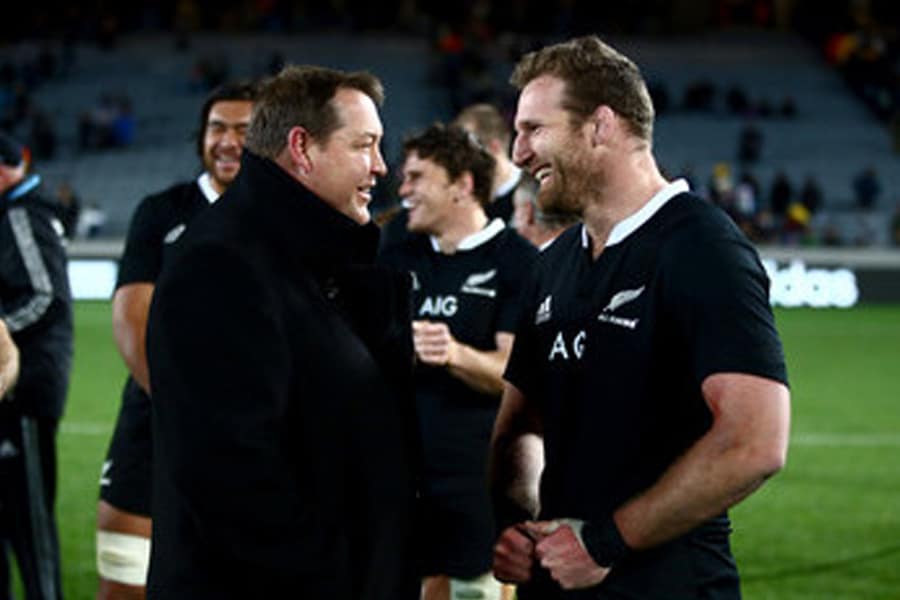
Coach Steve Hansen poses during an All-Blacks press conference at NewZealand Rugby House on April 10 2013

The All Blacks have also developed a unique leadership structure. At the top is skipper Richie McCaw who has now led the All Blacks in a phenomenal 100 test matches of which they have won 88. The Blacks also have a core group of senior players assigned to two different groups. The first group is in charge of leading on the field and the second is for off the field. The on-field group led obviously by McCaw is tasked with making all the decisions in the field of play. The likes of Conrad Smith, Keven Mealamu, Mils Muliaina, Kieran Read, Dan Carter, Andrew Hore and Tony Woodcock are or have been a part of this group. They decide the game plans to implement, what options are available to them and monitor players during the game. This group of leaders is also said to work very closely with the coaching staff in strategizing and implementing the game plans. On many an occasion McCaw has stated that this group is vital to the level of control the All Blacks display in the game.

The senior players are also responsible for bringing the younger players through the system. They are often seen helping the less experienced players through training sessions. One clear illustration is how Dan Carter seems to be grooming his under-studies Aaron Cruden, Beauden Barrett and Colin Slade. He appears to have taken them under his wing and is playing the role of a mentor which you don’t often see in rugby. The same applies to McCaw with Sam Cane and Matt Todd.

So often we see senior players like Carter, McCaw and Mealamu, even when injured or are being rested, on the side line running water in a game. These are three star players who have each played over a 100 test matches and certainly don’t need to be running around with a water-boy vest on, yet they are always around. This is something you will never see in any-other team from any sport. It is the equivalent of Lionel Messi running water for Barcelona FC, or Sachin Tendulkar pushing the drinks trolley on in the middle of a test match. These are tasks that players of this calibre would never undertake and it shows the character and humility of the senior All Blacks and more than all engraving the ether that nothing is too little or too demeaning a task for the cause of the ‘All Blacks rugby’ into the next generation.

The determination, guts and heart the All Blacks have displayed over past few years bars none in professional sports. Consider the coaches and McCaw after all the criticism he faced post RWC 07, the courage it would have taken him to step up and lead his team forward. It would have been very easy for him along with Graham Henry, Steve Hansen and Wayne Smith to simply walk away. Instead they learned from their mistakes, evolved and built a line-up of gladiators. McCaw’s audacity in the last three weeks of the world cup to have battled through on a foot with three fractures is a feat unheard of in sports.  “Better on one leg during the world cup than most players on two” was how Paul Ackford a renown rugby columnist described McCaw’s performance.

The next element of the All Blacks success is the depth they have accumulated in their squad. The coaching contingent have the options of 3 or 4 players in every position, each one capable of fitting into the side seamlessly. For instance, Carter who is arguably the best player of this generation if not every generation was out injured for an entire year. He was their best player and their most prolific goal kicker and the All Blacks still maintained their dominance in that year with Cruden slipping into his position. It is uncanny how the All Blacks can field a second choice or even a third choice squad and still be as good.

The All Blacks are a dominant force as a team but they also have individuals who put their hand up and prove their worth day in and day out. These singular performances have on many an occasion won games for the Kiwis. It is unconceivable how in the four out of the last five years an All Black has been named the IRB player of the year with McCaw, Carter, Read and most recently Brodie Retallick taking the honour.  The coaches have also collected decorations as the IRB coach of the year five years running; the invincible Sir Greame Henry 2010 and 2011 and lately in 2012,13,14 – Steve Hansen.

The All Blacks are also the fittest and strongest team out there. They make it a point to work on the fitness be it individually or within the team. New Zealand does not produce the biggest players in the world but they certainly produce some of the strongest. They have a very strict workout regimen paired with supplementation plans and dietary plans. The All Blacks have an entire retinue of behind the scenes staff who are in charge of their fitness, diet and health. The staff include a strength and conditioning coach, a dietary planner, team doctor and physio and even a mental strength coach who works on motivation and the mentalities of the players. They are fully qualified in their respective fields and provide the players with the best modern techniques of getting themselves both physically and mentally prepared for their games.

This overall preparedness is what makes the All Blacks such a force on the field. They are trained in how to handle every situation, be it an injury to a key player, a harsh referee or even a situation where they are trailing. This vigilance was on show in the end stages of the world cup; the method in which the team handled losing three play-makers, and having to hold-off a passionate France in the dying stages of the final proved how valuable that preparation was.

The All Blacks from 2010 through 2014 have arguably been the best if not the most dominant team in sporting history. This indomitable force from the deep south have built up an incomparable record and will look to seal it with a dominant 2015 by hopefully becoming the first rugby team to successfully defend the Webb Ellis cup.

Design a site like this with WordPress.com
Get started